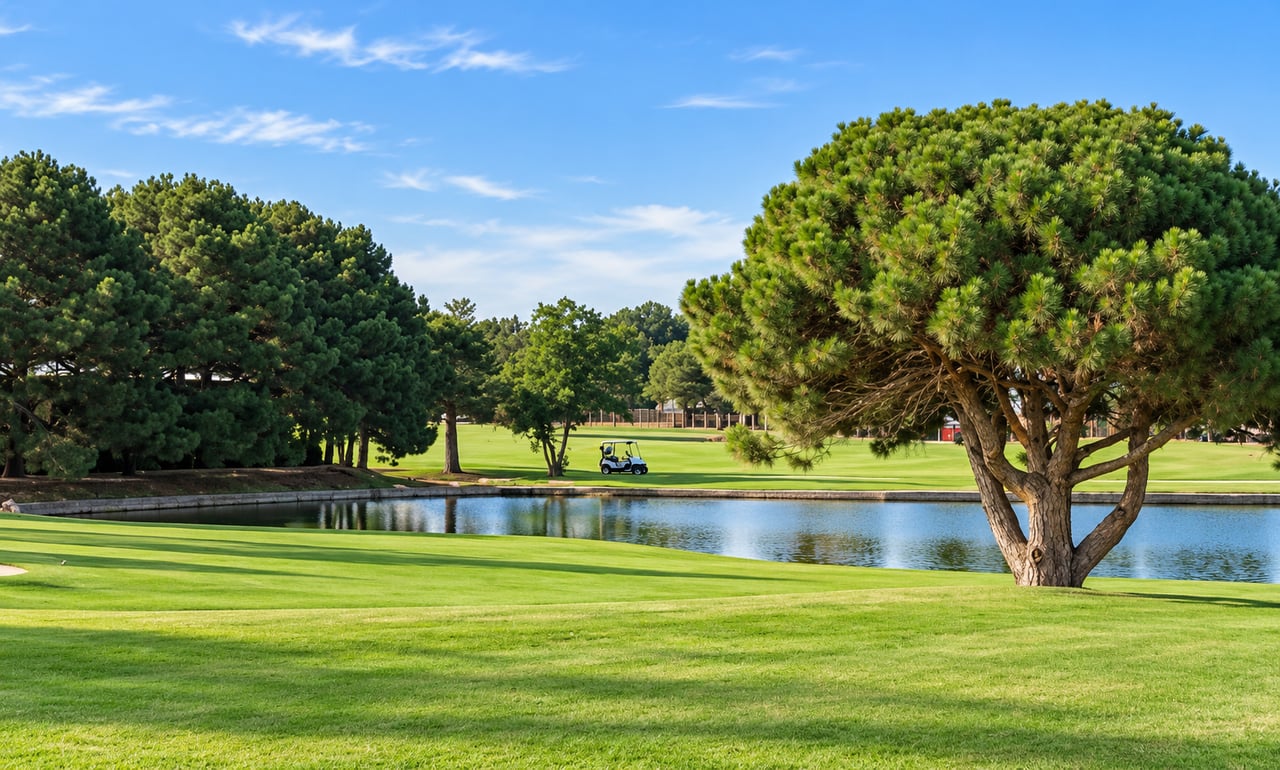
On a Tuesday evening in Green Tree, the car stays in the garage. A resident heads out the front door, climbs into a golf cart instead, and rolls down Greentree Boulevard in the dedicated cart lane that runs along the main road through the neighborhood. Ten minutes later, dinner is on the table in the clubhouse dining room. No one circled a parking lot. No one merged into traffic.
That trip is not a novelty. It is the actual infrastructure that decides how a week runs in Green Tree, and it explains more about daily life here than the golf course itself does.
A Lane Built for a Second Vehicle
Most Midland neighborhoods are built around one vehicle per errand. Green Tree was built around two. Greentree Boulevard carries regular car traffic and a marked golf cart lane running alongside it, and residents use it constantly, not just on the way to a tee time. The clubhouse dining room functions as a standing weeknight option precisely because members can leave the car at home and get there by cart.
Green Tree's layout is as much a part of daily life as its golf course. That layout matters less as a golf claim than as a practical advantage: homes back up to fairways, the club sits inside the loop of the neighborhood rather than at its edge, and the distance between a driveway and the pool, the tennis courts, or the par 3 course is measured in a walk of a few minutes, not a drive across town.
Six Years Under the Wheels
The ground that cart is rolling over has changed more in the last several years than in the previous three decades combined.
In 2018, Tripp Davis and Associates converted an open field members had been using informally to hit practice shots into a proper short course, a three-hole layout on nearly five acres that the club calls the Road Course, with its own short game and putting area attached.
That was the opening move. In 2022, the club's East Nine reopened for member play over Labor Day weekend after a full rebuild by the same design firm, and alongside it the club built a 20,000-square-foot lighted putting course called The Pine. Club COO Wray Crippin has described the redesigned East Nine as a shift from flat West Texas ground into a course with real movement in the fairways, an unusual outcome for this part of the state. By January 2023, Davis and his team were back on-site starting construction on the West Nine, working with contractor Course Crafters and project superintendent Terry Mausbac to rebuild every tee complex, fairway, bunker, and green, upgrading irrigation and shifting to Tif 419 Bermuda in the fairways and roughs with fine bent grass greens. Shaper Bill Willingham, credited by Davis for much of the course's new character, helped turn a naturally flat site into something with the kind of contour usually associated with sand belt courses half a world away. The West Nine opened in 2024.
Count it up and the club has rebuilt parts of itself over the six-year span from the Road Course in 2018 through the West Nine's 2024 debut, with two of its three nines completely redone along the way. For a member who has been riding a cart down the same lane since before 2018, the destination looks nothing like it used to, even though the route hasn't changed at all.
The Cart Ride Crosses Real History
None of this is the club's first act of ambition. Green Tree opened in 1980 under founding president John Wood, with a 36,000-square-foot clubhouse, tennis courts, a pool, and racquetball courts, and it had already signed up 225 members before construction was even finished. The man behind the idea, Jerry Mobley, had previously worked as head golf professional at Ranchland before deciding Midland could support a fourth club in a market that, even now, rarely supports three. He was right, and the neighborhood built around his course became one of the more established residential addresses in the Midland-Odessa area.
The current run of construction, from the Road Course in 2018 through the West Nine in 2024, reads less like a break from that founding ambition and more like a continuation of it. The club keeps rebuilding pieces of itself every few years, and residents keep riding the same lane past whatever is under construction that season.
What's Actually Within Cart Range
The list of things a member can reach without starting a car has grown rather than shrunk over the past few years:
- The clubhouse dining room, which regulars single out for a recurring pasta night that draws a crowd on its own
- The pool and tennis courts, along with a splash pad for younger kids
- The Road Course and The Pine putting green, both built specifically for practice rather than full rounds
- A fitness center that began a full renovation in 2025 under club manager Jayson, upgraded specifically to match the rest of the club's amenities rather than trail behind them
That last one is easy to miss because gyms don't generate the same kind of before-and-after photos a rebuilt nine does. But it tells you the club is treating wellness space as part of the same ongoing investment cycle as the golf course, not an afterthought bolted onto a 1980 clubhouse.
The Jr. League Fills Up Before the Season Starts
The clearest sign that this rhythm is still accelerating, not just holding steady, showed up this spring. Green Tree's 2026 PGA Jr. League season ran from April 1 through May 23, coached by Thomas Martin, with the team competing against Midland Country Club in a multi-facility format. Registration for the age 4-13 division reached capacity before the season even began.
A junior program filling up isn't a headline anywhere else. In a neighborhood this size, it's a data point. It means the families riding carts down Greentree Boulevard on a Tuesday for pasta night are the same families signing kids up for a golf league months in advance, and there were more of them this year than there were spots.
What This Adds Up To
None of these facts is dramatic on its own. A cart lane, a rebuilt nine, a gym upgrade, a full junior league roster. Put together, they describe a neighborhood that treats its own infrastructure the way a well-run small business treats its equipment: replace it before it becomes the reason someone leaves, and keep the daily routine exactly where people already know to find it.
That is the part worth sitting with if you already live here. The cart ride to dinner feels the same as it did five years ago. The ground underneath it isn't the same at all.
If you are weighing a move within Green Tree, thinking about how a renovated nine affects the value of a home that backs up to it, or simply want a straight read on what is changing in this part of Midland, I am happy to talk it through. Taylor Dickerson works this neighborhood directly and can walk you through what these changes actually mean for a specific address. Let's Connect.