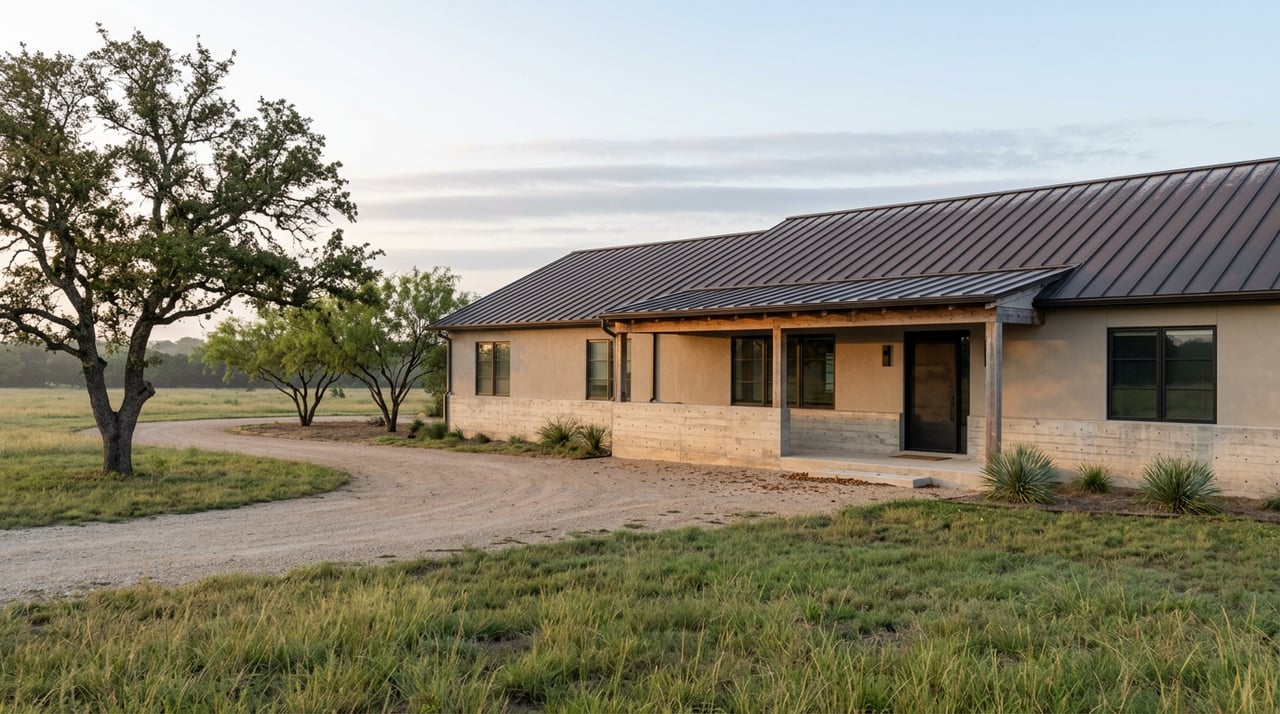
Drive the stretch of FM 307 that cuts through Greenwood and you will pass tracts that look nearly identical from the road. Same caliche shoulders, same mesquite fence lines, same price range per acre. What you cannot see from the truck is which side of a single dividing line each one falls on: whether the parcel is hooked into Greenwood Water Corporation's private grid, or whether the seller drilled a well because no line ever reached that corner of the property.
That distinction, not the acreage and not the asking price, is what actually determines how much cash you need before closing and how long the whole process takes.
A Private Company Owns The Water Here
Most buyers assume rural water in Texas comes from one of two places: a municipal system if you're close enough to town, or a well if you're not. Greenwood splits the difference in a way that surprises people who haven't worked this corridor before.
Greenwood Water Corporation has served residential and commercial customers in the area since 1982, when Paul Wilhite founded it. In 2015 the Public Utility Commission of Texas approved the sale of the company's stock to Permian Basin Water Resources, LLC, a group the utility describes as experienced operators with other holdings in the Midland and Greenwood area. That sale matters because it means the water running to a home on this grid isn't managed by a city council or a member-owned cooperative. It's managed by a private, investor-owned utility answering to the state's utility commission rather than to local voters.
For a buyer, that changes the questions worth asking before you write an offer. A municipal system answers to a city budget and a public meeting schedule. A private utility answers to its owners and to the PUC's rate and service rules. Neither structure is inherently worse, but they carry different maintenance incentives and different channels if something goes wrong.
And things do go wrong on any pressurized system. Greenwood Water Corporation's own customer portal carries a standing operational notice describing what happens when mainline pressure drops below the required threshold: the utility is required to start "issuing a Precautionary Boil Water Notice" until pressure and safety are confirmed again. That's not a knock on the company. It's simply the reality of being on a shared grid instead of your own private source, and it's worth knowing before you sign, not after you've moved in.
The Well Option Has Its Own Math
Plenty of Greenwood tracts, especially the larger ones further off the water corp's main lines, still rely on a private well. Listings across the area routinely describe properties as sitting on well and septic rather than a metered utility connection, and that's true whether the tract is a small residential lot or a multi-acre commercial parcel.
A well isn't a fallback option here. It's a real capital decision. Well drilling in this part of Texas runs roughly $8,000 to $30,000 or more in 2026, with the final number driven by depth and which aquifer you're tapping. Midland County wells typically draw from the Edwards-Trinity Plateau aquifer or the Ogallala, and both are known locally for hard water with elevated total dissolved solids. That's not a deal breaker, but it is a line item: budget for water treatment or softening on top of the drilling cost itself, and factor that into what you're actually paying to make the property livable.
Septic Doesn't Care Which Water You Chose
Whichever side of the water line your tract sits on, the septic question runs on its own separate track through Midland County, and it has its own timeline that catches buyers off guard.
The county requires a TCEQ-permitted on-site sewage facility for any property without access to a municipal sewer line, and Greenwood, sitting outside Midland's city limits, falls squarely in that category. Before you can get a permit, a licensed soil scientist has to evaluate the site to determine what kind of system the ground will support. New installation permits generally run $200 to $500, repair permits run $100 to $300, and the full process from soil evaluation to approved permit typically takes two to six weeks depending on scheduling and how complete your application is. If the system on the property is an aerobic unit rather than a conventional septic tank, expect it to require inspection three times a year by a licensed maintenance provider, an ongoing cost that doesn't show up on a listing sheet.
There's one wrinkle that can work in a buyer's favor. Properties of ten acres or larger with a single-family dwelling may qualify for what the county calls the 10-acre exemption, which changes the permitting requirements entirely. It's worth confirming with the Midland County septic and sewer permitting office early, because whether a tract qualifies can shift your timeline by weeks in either direction.
What Water Corp vs. Well Actually Costs You
| On Greenwood Water Corp | On a Private Well | |
|---|---|---|
| Upfront cost | Utility hookup or existing connection fee | $8,000 to $30,000+ for drilling, plus treatment for hard water |
| Ongoing risk | Subject to shared-system events like pressure-related boil notices | Full owner responsibility for pump, casing, and water quality |
| Regulatory oversight | Public Utility Commission of Texas | County health department for septic only; well itself is largely unregulated once drilled |
| Septic requirement | Same TCEQ permitting process applies regardless of water source | Same TCEQ permitting process applies regardless of water source |
Notice that the septic row is identical either way. Water source and wastewater are two separate systems with two separate cost structures, and a buyer who only budgets for one of them is going to be surprised by the other.
What To Confirm Before You Write An Offer
- Ask the seller in writing whether the property is on Greenwood Water Corporation service or a private well, and get the account or well permit documentation to back it up.
- If it's on Water Corp service, confirm the account is active and in good standing rather than assuming a meter on the property means a live connection.
- If it's on a well, request the well log and, where available, a recent production or flow test rather than taking "good well" as a verbal assurance.
- Check whether the tract's size qualifies for the county's 10-acre septic exemption before you assume standard permitting timelines apply.
- Budget separately for water treatment if the well draws from the Edwards-Trinity or Ogallala aquifer, since hard water and elevated TDS are common in this part of the county.
- Build septic permitting time into your closing calendar. Two to six weeks is the stated range, and soil scientist scheduling is usually the variable that pushes it toward the longer end.
None of this shows up in the photos or the price per acre. It shows up in the closing disclosure and in the first year of ownership, which is exactly why it needs to be settled during due diligence rather than discovered afterward.
FAQ
Does every property in Greenwood have access to Greenwood Water Corporation? No. Coverage follows the utility's existing lines, and tracts further from the main corridor along FM 307 often rely on private wells instead. Confirm status property by property rather than assuming based on the general area.
Can I drill a well on a tract that already has Water Corp service? That depends on the specific parcel and any restrictions tied to it, so this is a question for the utility and a local well driller before you assume it's an option, not after.
Does the 10-acre septic exemption apply automatically once I own ten acres? No. It's tied to the property meeting the county's specific criteria for a single-family dwelling on that acreage, so confirm eligibility with the county rather than assuming it applies.
If you're weighing a Greenwood tract and want someone who has actually worked through the water-source and septic-permitting side of these transactions, Taylor Dickerson can walk you through what a specific property will actually cost to bring online, not just what it's listed for. Let's Connect.